

Smoke, memory and beginning: A scholar’s perspective on Welcome to Country
Posted: 14 July 2026
Australia Awards – South Asia & Mongolia supports scholars to engage with Indigenous Australians.
During NAIDOC Week, we are sharing this account of a Welcome to Country and Smoking Ceremony by Zoha Shakir, a Pakistani scholar at the Australian National University (ANU), in her own words.
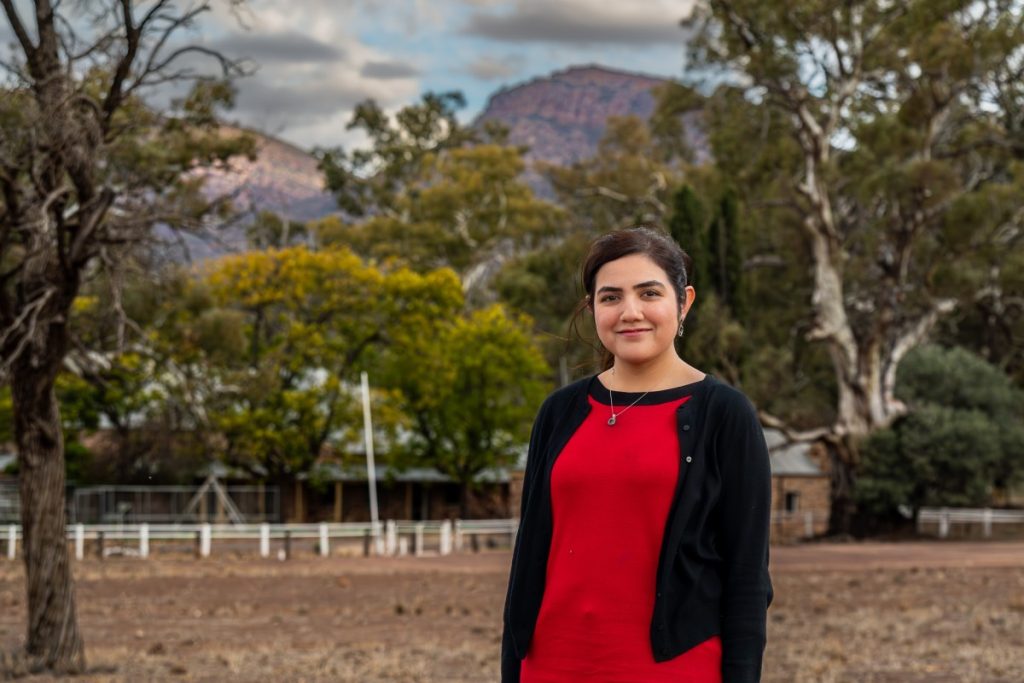
Scholar Zoha Shakir from Pakistan.
It was a beautiful, sunlit afternoon. The rain from the night before still lingered in the air, and the scent of wet soil rising from the grass felt calming, almost sacred. The ANU lawns, which had felt deserted and lifeless just a week earlier, were now breathing again, revived by the presence of people and their stories. Students gathered from different parts of the world, some brimming with excitement, others quietly anxious about what lay ahead. Unfamiliar faces searched for connection, ready to share fragments of their stories with strangers who might soon become friends. Senior students stood confidently, reuniting with familiar circles. Newcomers who had just arrived in Australia with a suitcase full of clothes and eyes full of dreams scanned the crowd, hoping to find people they could belong with.
It was the Welcome to Country and Smoking Ceremony organised by the ANU College of Law, Governance and Policy (CLGP), marking the beginning of the semester with warmth and belonging.
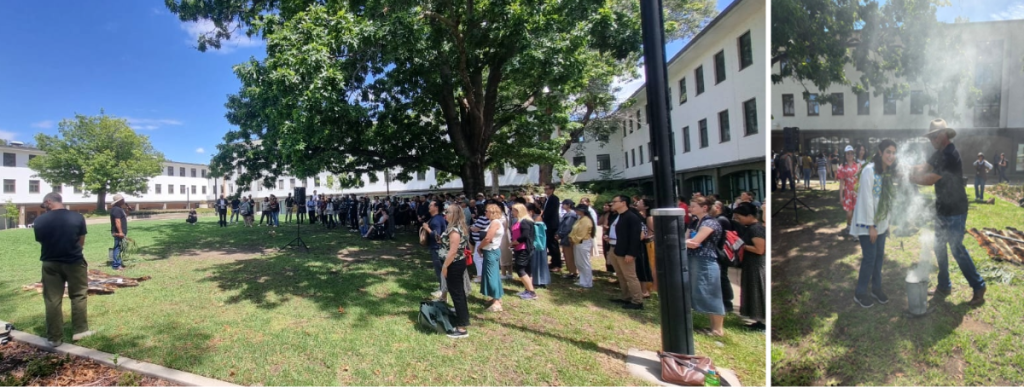
Scenes from the Welcome to Country and Smoking Ceremony held on the ANU CLGP lawns.
A Welcome to Country is not a formality, nor is it a script. It is an act of cultural authority. When a Traditional Custodian welcomes visitors, they speak on behalf of their ancestors, their kin and the land itself, extending protection, safe passage and respect. Long before campuses, roads or institutions existed, crossing into another group’s land required permission. Boundaries were known. Protocols were honoured. That day at ANU, those protocols lived again.
Professor Tony Connolly, Dean of CLGP, opened the gathering with words of encouragement and hope for the year ahead, reminding students of the journey they were about to begin. This was followed by the Smoking Ceremony conducted by Paul House, Ngambri-Ngunnawal custodian.
Paul began by acknowledging the Ngunnawal and Ngambri people as the Traditional Custodians of the land. His words carried weight. There was pride, but also a quiet sorrow when he said, “Our land was once stolen without consent or treaty.” Yet there was strength too, laying a firm reminder that now they “take responsibility and uphold the values”. As he welcomed us onto Ngambri-Ngunnawal land, he reaffirmed something powerful: that the land beneath ANU is not empty space. It holds memory. It holds responsibility. It holds ongoing custodianship.
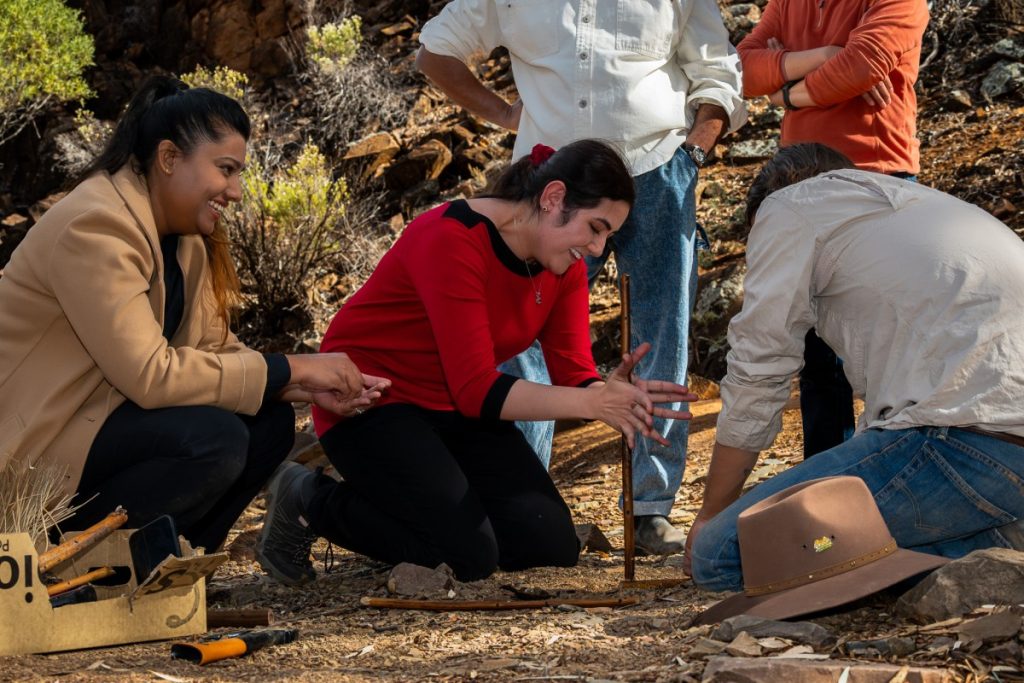
Zoha (middle) trying her own hand at traditional fire-making with Adnyamathanha guide Izzy (right) during a study tour for scholars to the Ikara-Flinders Ranges National Park in South Australia in 2025.
When Paul spoke of respect, that respect shapes people who care for one another, his words settled gently in the heart. It felt like an invitation to step beyond ourselves and see the world through kinder eyes. His message quietly urged empathy over judgment, reminding us that harmony begins with understanding. It took me back to Atticus Finch’s lesson in To Kill a Mockingbird: that to truly understand someone, we must “climb into their skin and walk around in it”. In that moment, his words did not feel like advice, but like a value we were all being asked to carry forward.
Then the fire was lit, and with it began the Smoking Ceremony, the most anticipated moment of the afternoon. Native leaves were gently placed onto the glowing embers, and soon aromatic smoke began to rise into the open air. The emu bush, known for its medicinal and cleansing properties, burned slowly, its scent soft yet powerful. It felt like magic, sacred wisdom carried through generations. The smoke drifted towards us like a quiet blessing, believed to cleanse people and places, to ward away harmful spirits, and to invite wellbeing. One by one, people stepped forward, allowing it to wash over them.
The smoke felt like a gift.
A blessing.
A bridge between the physical and the spiritual.
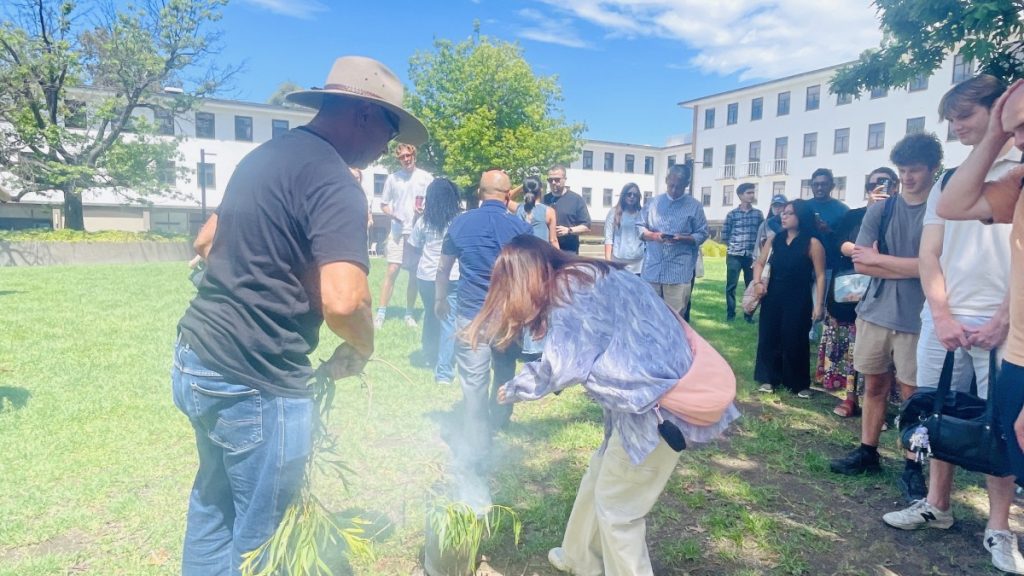
The beginning of the Smoking Ceremony held on the ANU CLGP lawns.
As it rose into the sky, it carried something invisible yet deeply felt: a connection. It seemed to weave together past and present, elder and student, land and learning. It reminded us that education does not happen in isolation from place. Knowledge is not detached from land. Progress need not come at the cost of memory.
For me, attending that ceremony felt like witnessing something both ancient and deeply personal. I have always cherished diversity, but this felt like something beyond diversity. It felt like continuity, like culture alive and breathing in the present moment. It made me realise that the ceremony was not just about history; it was about resilience, about care, and about honouring the enduring relationship between First Nations peoples and Country.
That day left behind more than smoke in the air. It left behind a quiet awareness; lessons in kindness, in humility and in walking gently on land that holds stories older than any institution. It left us a little quieter, a little kinder. And as we move through the year ahead, we carry that respect and gratitude with us, in our steps, in our conversations and in the way we choose to see one another.