Pakistani scholar Shamsa Yousaf reflects on study tour in Ikara-Flinders Ranges National Park
Posted: 9 July 2026
On 22–25 May 2026, Australia Awards scholars from South Asia and Mongolia travelled to Ikara-Flinders Ranges for an immersive experience on Adnyamathanha Country. The scholars learnt about the Adnyamathanha people, their culture and their connection to Country under the guidance of John Solar, a Yura man and Adnyamathanha cultural educator.
This NAIDOC Week, we share Pakistani scholar Shamsa Yousaf’s reflections on this trip in her own words.
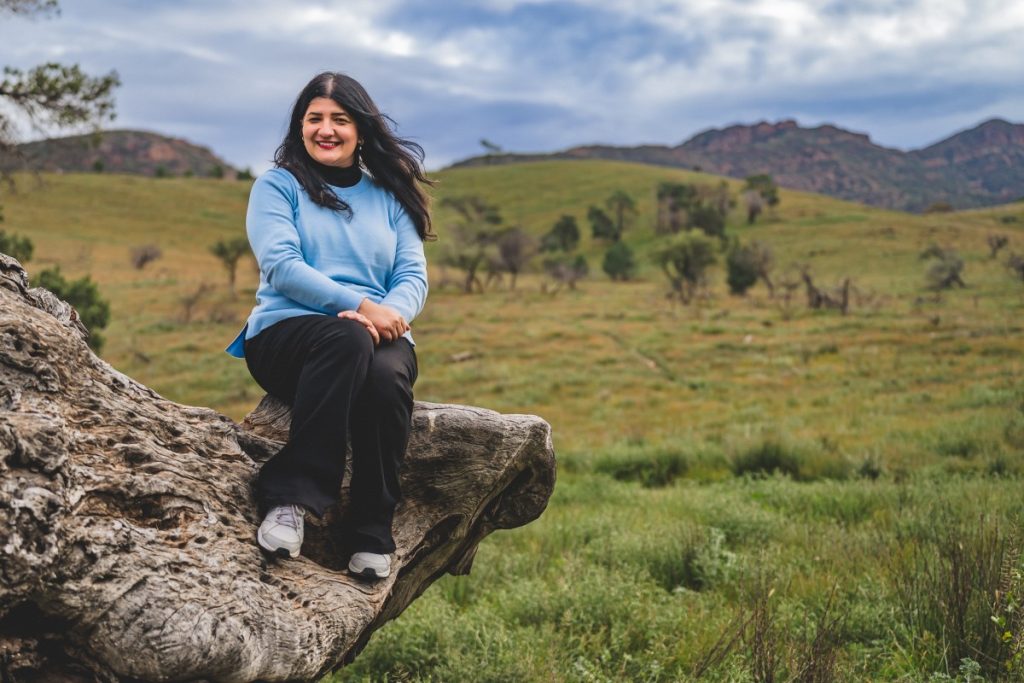
Shamsa pictured at Ikara-Flinders Ranges National Park.
Our visit to Adnyamathanha Country was one of the most memorable experiences of my studies in Australia. Over three days, I learnt about Adnyamathanha culture, traditional knowledge, the importance of Country, and the deep connection between people, land, animals and stories. Overall, the experience helped me understand knowledge in a broader and more human way, and showed how culture, nature and identity are closely connected.
Our journey began with a Welcome to Country led by our Adnyamathanha guide, John Solar. He spoke in language, welcomed us onto Country through a smoking ceremony and shared the meaning of the Adnyamathanha flag along with parts of his personal story.
One of the key lessons John shared was about fire. Before this experience, I understood fire mainly in scientific terms, as something requiring fuel, oxygen and a spark. However, John explained that while this is the physical explanation, fire also carries cultural and spiritual meaning. During the smoking ceremony, plants were placed on the fire to create smoke that welcomed us onto Country. The smoke is believed to cleanse people of negative thoughts and energy, allowing them to enter Country with respect and a clear mind. This helped me realise that fire is not only physical, but also symbolic of cleansing, respect and connection to land.
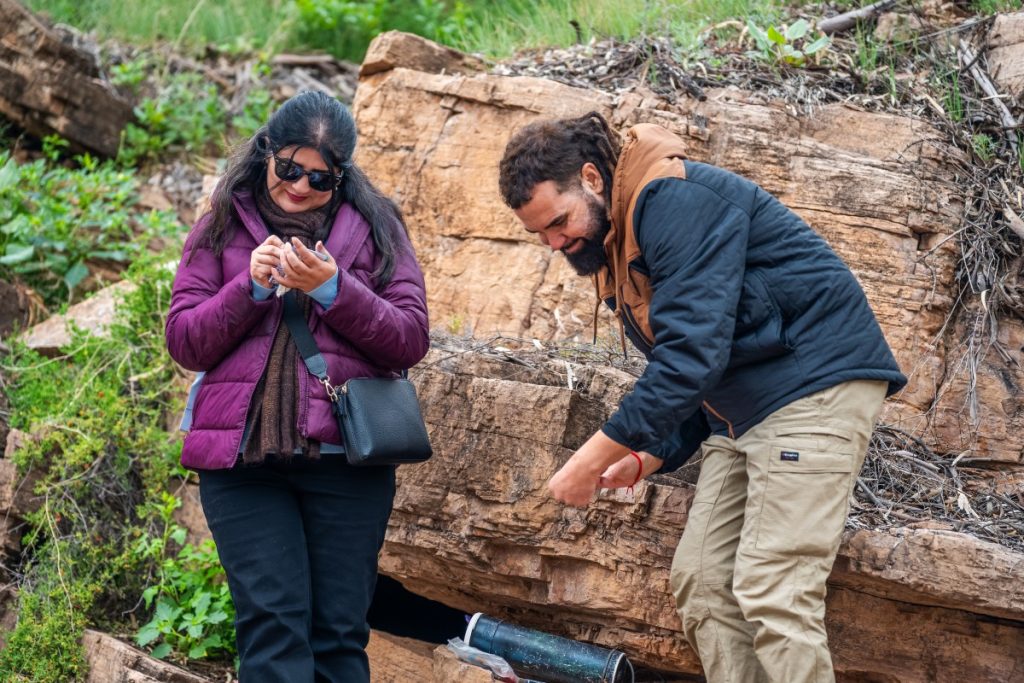
Shamsa (left) interacting with guide John (right) during the study tour.
Afterwards, we travelled to Stokes Lookout, where John shared Yura Muda, the creation stories of the Adnyamathanha people. These stories explain how the landscape was formed and connect people deeply to Country. As the sun set, John asked us, “What is in your backpack?” At first, I thought of physical items, but he was actually referring to the values we carry in life. This simple question made me pause and reflect on qualities such as respect, empathy, openness and forgiveness, and how they shape the way we interact with others in everyday life.
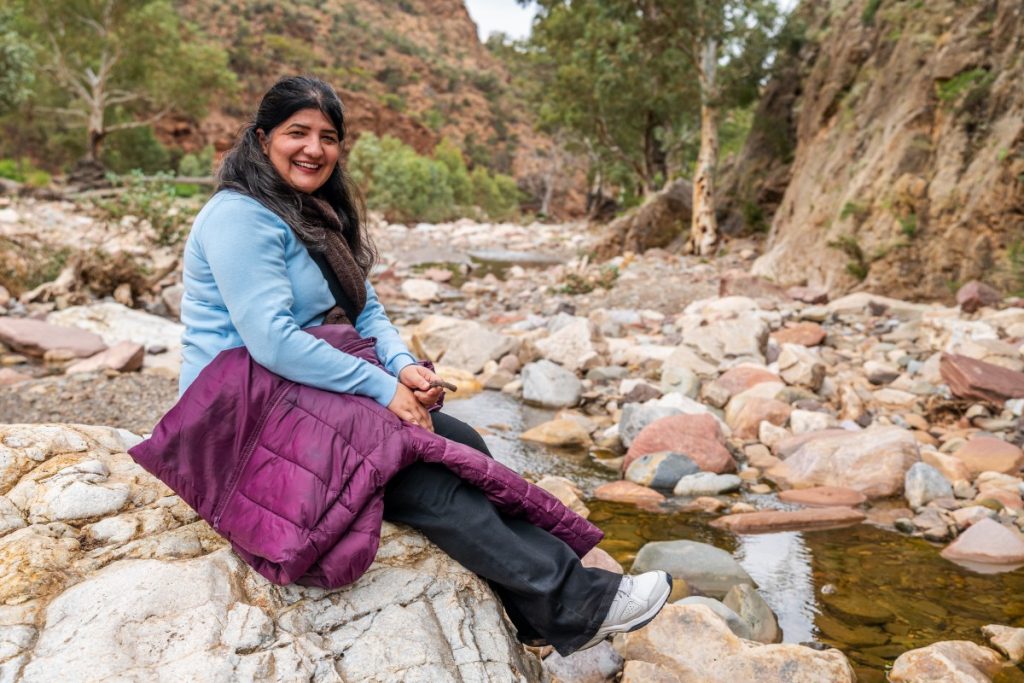
On Saturday morning, we travelled along the Brachina Gorge Geological Trail, where we saw ancient fossils and geological formations. John explained that this landscape was once an inland sea, which is evident through stromatolites and fossilised marine worm burrows. Interestingly, the absence of fish bones added another layer of curiosity to the site. Seeing this helped me appreciate how Earth’s history is literally written into the land.
Alongside the geology, John also explained the cultural importance of local plants used for food, medicine and ceremonies. I found it fascinating how Indigenous communities developed such detailed knowledge of the natural environment long before modern science existed, and how this knowledge continues to be passed on through storytelling, observation and lived experience.
In addition, we observed yellow-footed rock-wallabies. John explained how their population once dropped to around 40 individuals, but has now recovered to over 1,000 through conservation efforts involving both traditional owners and scientists. Seeing kangaroos and rock-wallabies throughout the journey also made me reflect on how closely animals are connected to Country and cultural storytelling.
Another important aspect of the visit was learning that Ikara-Flinders Ranges National Park is co-managed by Adnyamathanha representatives and the South Australian Government. This stood out to me because it showed how traditional knowledge and scientific approaches can work together in environmental management and conservation, rather than being separate systems.
On Saturday evening, John demonstrated how to start a fire using traditional methods and prepared damper bread for us to share. Sitting around the fire, sharing food and watching the smoke rise created a strong sense of community. It was a simple moment, but a meaningful one, as it reflected how fire brings people together in both cultural and social ways.
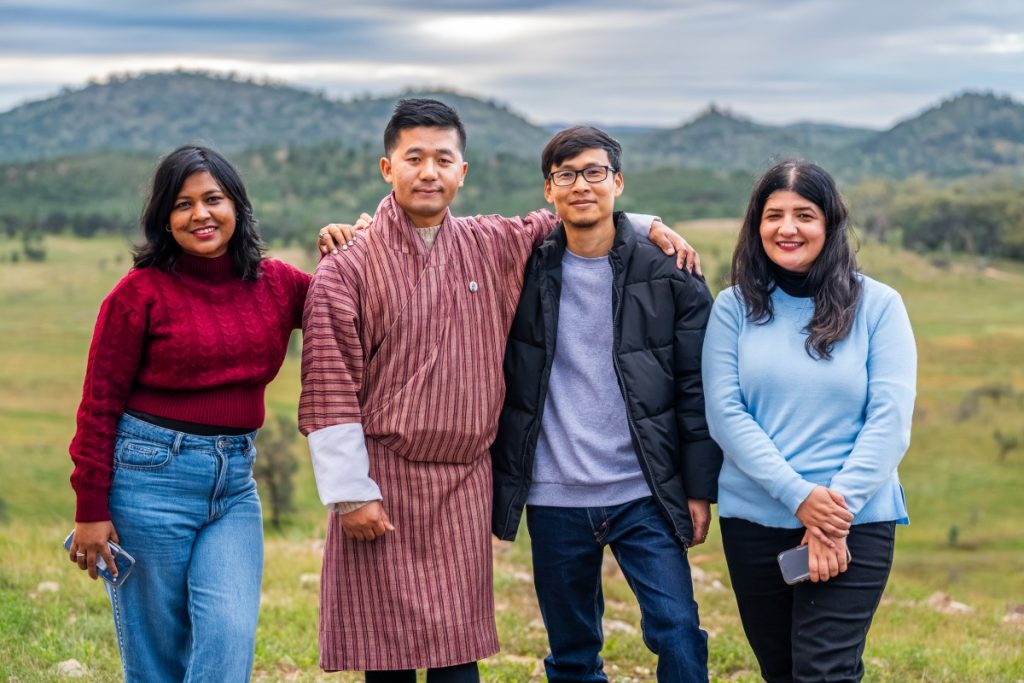
Shamsa (right) pictured with other scholars from Bangladesh and Bhutan.
Later, we went on a night walk under the stars. John explained how Indigenous peoples used the stars for navigation and understanding the environment. Listening to stories about animals, ancestors and respect for Elders while walking quietly through Country created a calm and reflective atmosphere. In that moment, I realised that storytelling is not only about history, but also about teaching values, behaviour and responsibility in everyday life.
On the final day, we hiked to Akurra Adnya (Arkaroo Rock), one of the most culturally significant sites in the region. The ancient rock paintings show creation stories, animals and connections to Country, and have been preserved for thousands of years.
Standing in front of the paintings made me reflect on how knowledge was recorded long before written systems existed. It also reminded me how deeply human life has always depended on nature for survival, identity and meaning.
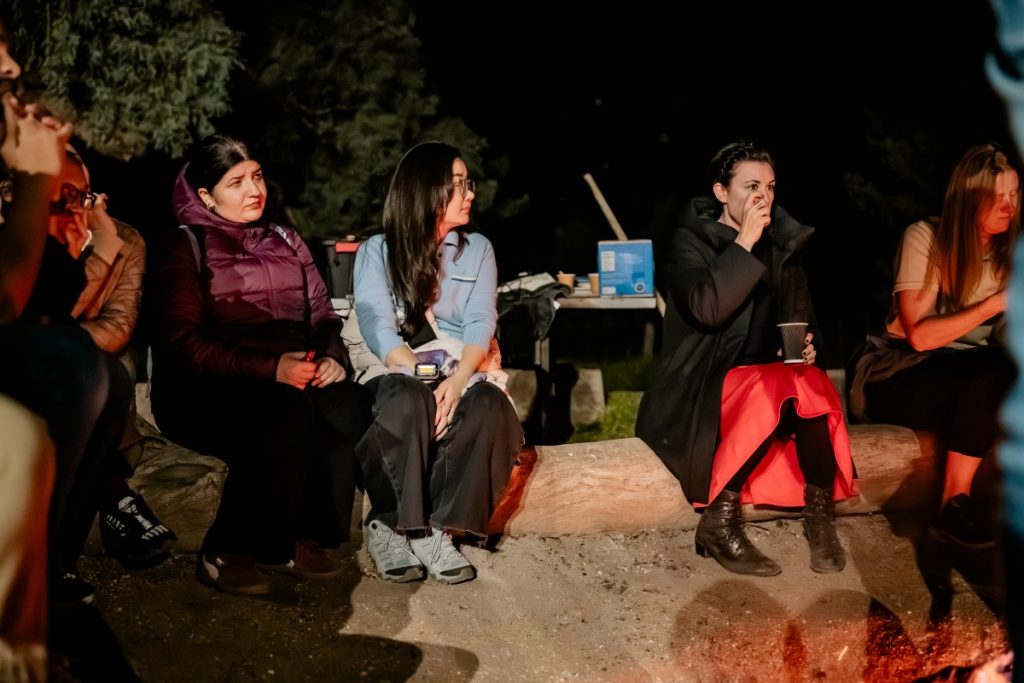
Shamsa listening to … after engaging in a fire-making exercise.
At the end of the visit, John lit a farewell fire. He explained that it removes negative energy and provides safe passage as visitors leave Country. It was a respectful and thoughtful way to conclude the experience.
Overall, this experience changed the way I think about knowledge, land and environmental governance. I realised that knowledge is not only scientific or written, but also lived, shared, and passed through culture, storytelling and experience. In particular, I understood that climate change cannot be addressed only through top-down policies or technical solutions; it also requires the inclusion of local communities and traditional knowledge systems.
This made me think of Pakistan, especially northern regions and communities such as those in Chitral, where people continue to live closely with land, seasons and natural cycles. Like Australia, these regions are also facing increasing climate pressures, including floods and changing weather patterns. As a result, it becomes even more important to recognise and protect local knowledge in climate adaptation and sustainability planning.
In conclusion, whether through fire, ancient fossils of an inland sea, stories of kangaroos and stars, or walking through sacred landscapes, I learnt that Country is not just a place. It is a living system of knowledge that connects people across time.